The Packing List That Actually Works
- The Well Packed Woman

- Apr 19
- 4 min read
Updated: Apr 26
How to Build a Master Packing List You'll Use Every Trip
Save this to your travel planning board on Pinterest ↓
A note: this post contains affiliate links. If something here finds its way into your bag, I may earn a small commission. It costs you nothing extra, and I'd never recommend anything I wouldn't travel with myself.
Every packing mistake has the same root cause.
Starting from scratch.
A new list for every trip, built from memory, assembled under time pressure, abandoned halfway through when it feels close enough. Something always gets forgotten. Something else gets packed that never gets touched. The cycle repeats.
The master packing list breaks the cycle. Not a list you write before a trip, a list you build over time, refine after every trip, and arrive at eventually as the one document that knows exactly what you need. Built once. Used forever.
Why Most Packing Lists Don't Work
The problem with a generic packing list is that it isn't yours.
It was written for someone else's trip, someone else's industry, someone else's tolerance for checking a bag.
It accounts for things you never need and misses the things that are specific to how you travel.
The decision filter applies here as much as anywhere. The goal is to make decisions once, in advance, so you're not remaking them under pressure every time you travel. A master packing list is that decision, codified.
The Structure: Four Categories
A master packing list that works covers four things and nothing else.
Clothes. Not a specific outfit list: a formula. Two bottoms, three tops, one blazer, two pairs of shoes. The Work Trip Uniform is already this. Your clothes section of the list is just confirming the formula is complete.
Toiletries. The edited version: not your full bathroom, just what you actually need to feel like yourself. This section rarely changes. Once it's right, it stays right.
Tech. Laptop, charger, phone charger, earbuds, adapters, tech organizer. Everything that has a cord gets its own line. Tech is where most people forget things because it lives in too many places at home.
Documents and essentials. Passport or ID, credit cards, loyalty cards, any prescriptions, cash if the trip calls for it. This is the section you check last, the night before you leave, when the bag is already closed.

Building Your Master List
Start with a trip you've taken recently, one that felt representative of how you usually travel.
Write down everything you packed. Then note what you actually used. The gap between those two lists is where your master list begins.
Everything you used goes on the master list. Everything you didn't gets questioned. Was it a legitimate backup that just wasn't needed, or was it wishful packing? Be honest. Wishful packing is the enemy of a list that actually works.
After the next trip, repeat. Add what you forgot. Remove what went untouched again. After three or four trips, the list stabilizes. That's your master list.
The Carry-On Edit is the packing structure that makes the list executable. Once you know what goes in, the cubes and organization do the rest.
The Variables: What Changes Trip to Trip
A master list has two layers: the fixed core and the trip-specific additions.
The core never changes. Toiletries, tech, documents, the formula. It's the same whether you're going to Chicago for two days or London for a week.
The variables sit on top. Climate-specific pieces like a heavier layer, a rain jacket, a different shoe. Trip-specific items such as a formal outfit for a gala, a swimsuit for a resort, workout gear if the hotel gym is actually good. These get added and removed as needed, but they never destabilize the core.
Keeping them separate is what makes the list reusable. The core is always ready. The variables take five minutes.
Making It Yours
A master packing list lives somewhere you'll actually use it.
A note on your phone. A document in your files. A printed card tucked into your carry-on. The format doesn't matter, the accessibility does. If it takes more than ten seconds to find it before a trip, it won't get used.
Review it twice before you pack. Once when you're planning to confirm the core is covered and add your variables. Once the night before to check that everything on it made it into the bag.
That second check is the one that catches the things you meant to pack but forgot to actually put in.

Want this list as a beautifully designed PDF you can save and use before every trip? Download your free Carry-On Packing System here."
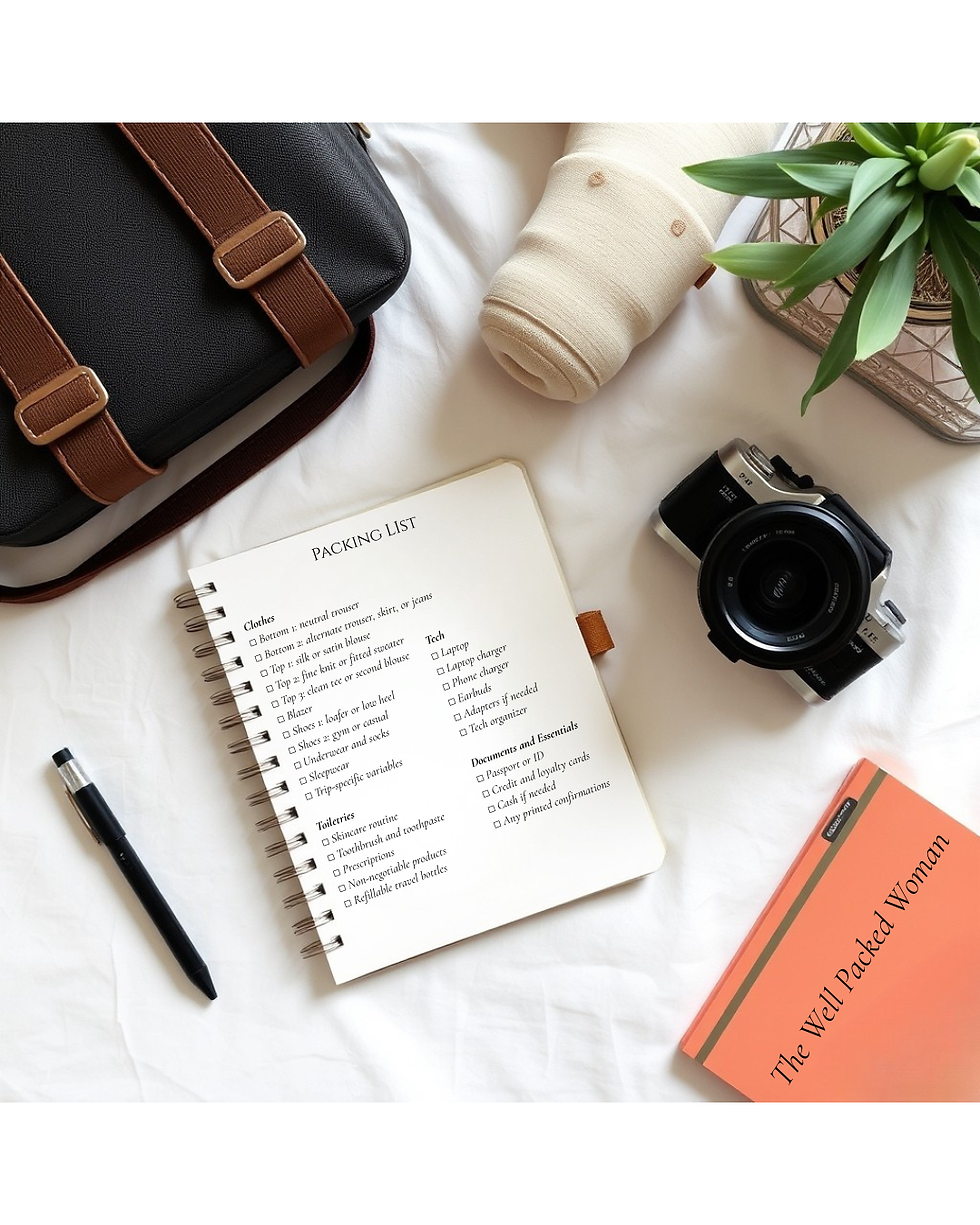
The Master Packing List
Here's a starting framework — edit it to match how you actually travel:
Clothes
☐ Bottom 1: neutral trouser
☐ Bottom 2: alternate trouser, skirt, or jeans
☐ Top 1: silk or satin blouse
☐ Top 2: fine knit or fitted sweater
☐ Top 3: clean tee or second blouse
☐ Blazer
☐ Shoes 1: loafer or low heel
☐ Shoes 2: gym or casual
☐ Underwear and socks
☐ Sleepwear
☐ Trip-specific variables
Toiletries
☐ Skincare routine
☐ Toothbrush and toothpaste
☐ Prescriptions
☐ Non-negotiable products
☐ Refillable travel bottles
Tech
☐ Laptop
☐ Laptop charger
☐ Phone charger
☐ Earbuds
☐ Adapters if needed
☐ Tech organizer
Documents and Essentials
☐ Passport or ID
☐ Credit and loyalty cards
☐ Cash if needed
☐ Any printed confirmations
Build it once. Refine it twice. After that, packing stops being something you figure out before every trip.
It becomes something you simply do.
The three systems every calm traveler uses all work the same way, decisions made in advance so the moment itself is effortless. The master packing list is where that starts.
Sincerely,
The Well Packed Woman


Comments